Private WordPress
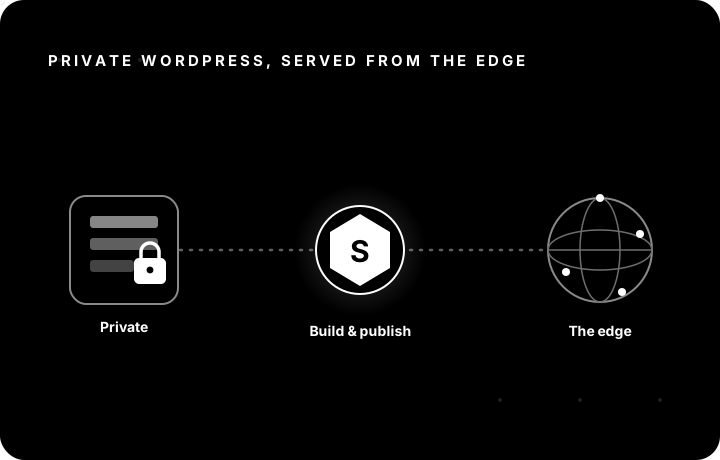
WordPress runs in your own environment - and never answers the open web.
- On premises or private cloud
- Behind a VPN or Zero Trust
- No public HTTP / HTTPS

SolidSite is your private WordPress publishing platform. We take WordPress off the public internet and serve your finished site from the edge - fast, secure and private.
SolidSite keeps WordPress where it belongs: locked away in your own private environment, never exposed to the open web. Your team keeps publishing exactly as they do now, and the SolidSite plugin builds a fast static version of your site right inside WordPress, then pushes it out to the edge of the internet. No public PHP, no database on show, no attack surface to defend - just a site that loads instantly and stays online even when WordPress is off.
For now, SolidSite is in private beta and open to just a select number of teams. You're welcome to register your interest or chat with us to find out more.
Your content stays in WordPress. Your website is delivered from the edge - so there is nothing public to attack and nothing slow to load.
No public access to your server.
Delivered from the edge, everywhere.
No PHP, no database, no attack surface.
Incremental, atomic, instantly live.
Online even if WordPress is offline.
WordPress runs in your own environment - and never answers the open web.
A plugin inside WordPress builds your static site and pushes it out.
Your site is served to visitors from the edge of the internet.
Visitors get a fast, secure experience anywhere. Forms and search still work - handled through outbound polling, so your WordPress never needs inbound traffic.
The result: A WordPress site that is invisible to attackers, lightning fast for visitors, and always on.
The SolidSite plugin runs inside WordPress and renders your pages to static HTML - all locally, with nothing exposed to the internet.
It assembles the static site, capturing only what changed for fast, incremental publishing.
Pages and assets are optimised for speed so every one is ready to serve the instant a visitor asks for it.
The plugin pushes the finished site out to the edge - an outbound push, so WordPress never has to accept an inbound connection.
No. Your team keeps writing and editing in WordPress exactly as before. SolidSite handles publishing and delivery quietly in the background.
Yes. SolidSite works with the tools you already rely on - Elementor, ACF, Gravity Forms, Forminator, SEO and analytics plugins, and thousands more.
The SolidSite platform captures form submissions and search queries at the edge and passes them to your WordPress through outbound polling. Your site reaches out to collect them, so forms and search keep working without WordPress ever accepting an inbound connection.
Your live site keeps running. Because visitors are served a static copy from the edge, your presence stays online even while WordPress is down for maintenance, updates or an outage.
Anywhere private - on premises, a private VPC or cloud, or behind a VPN, Zero Trust access or Tailscale. SolidSite only needs a secure outbound connection to it.
SolidSite is currently in private beta. Speak with us to learn more and register your interest in early access.
You cannot attack what you cannot see. SolidSite takes WordPress off the public internet entirely.
WordPress runs a huge share of the web, which is exactly what makes it the single biggest target on it. SolidSite's answer is refreshingly blunt: stop putting the engine on the public internet at all.
Almost every WordPress horror story starts the same way - an open door nobody meant to leave open. A plugin a version behind. An exposed login page being tried thousands of times a night by bots that never sleep. A database sitting one misconfiguration away from daylight. The usual response is an arms race of firewalls and scanners, all working furiously to defend something that did not need to be publicly reachable in the first place.
SolidSite takes the target off the board. WordPress stays in your private environment - on your network, in a private cloud, behind a VPN or Zero Trust access - and never answers a request from the open internet again. There is no public PHP to exploit, no database to reach, no admin page to brute-force. You cannot attack what you cannot see, and to the outside world your WordPress simply is not there.
What visitors get instead is a fast, static copy of your site, published in seconds and served from the edge of the internet - close to wherever they happen to be. Static pages have no code to execute and nothing to inject, so they are both dramatically faster and dramatically safer. The result feels less like a website and more like infrastructure: quick, quiet and hard to knock over.
Publishing stays effortless because nothing about your day changes. Your team writes and edits in the WordPress they already know, hits publish, and the SolidSite plugin builds the change and pushes it live - atomically, with a full version history and a one-click rollback if a change ever needs undoing. The plugins you depend on keep working; the workflow you trained everyone on stays intact.
And because the live site no longer depends on WordPress being reachable, your presence stops being fragile. Update plugins in the middle of the day. Take the server down for maintenance. Weather a traffic spike that would have flattened a normal install. Through all of it, the version your customers see keeps loading - fast, secure and online. That is the quiet promise of SolidSite: your content still lives in WordPress, but your website no longer has to depend on it.
Locking the backend behind Zero Trust or a VPN helps - but the public site still runs on WordPress. SolidSite removes the public runtime entirely. Here is how the three approaches stack up.
Summary comparison of common approaches - your exact setup may vary. WordPress + Zero Trust refers to the common enterprise setup of the backend only protected by Zero Trust, while the frontend remains public.
We're onboarding a small group of teams while we refine it. If private, edge-served WordPress sounds like what you need, speak with us to learn more and register your interest in early access.